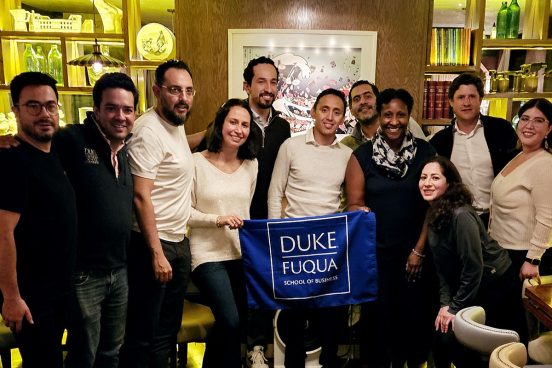
Gaining New Perspectives at TEDxDuke

A couple months ago, I had the awesome opportunity to attend a TEDx event – TEDxDuke! Having watched numerous TED talks online during the last couple of years, I really wanted to attend a TED event. I just didn’t think one of these events would happen in North Carolina, let alone in Durham or at the Duke campus.

tedx

The TEDxDuke event focused on "A Shrinking World."

The event itself was fast paced with about a dozen different talks. There were breaks in between to allow interaction with the speakers and for refreshments. I specifically mention refreshments because MBA students have a reputation for liking events with food. And it’s not entirely untrue!

This year’s event focused on the theme, “A Shrinking World.” While it certainly seems like a fairly obvious notion, the opportunity to hear a lot of different perspectives on it was truly enlightening. The event also included student speakers, and I was pleasantly surprised by the high quality of their talks.

While it’s difficult to list all talks and even more difficult to pick a few, I do want to highlight some speakers that I really enjoyed:

  1. Mike Schoenfeld: As Vice President of Public Affairs and Government Relations at Duke, Mike is the chief spokesperson of the university and he opened the conference. He introduced the idea that the world’s shrinking is a by-product of its expansion — expansion of human understanding of complex subjects including science and technology. He cited One Day at Duke as an example of the shrinking-expanding contradiction. Very fascinating!
  2. Brian OliverSmith: Brian is the founder of an education tech start-up called Urban Planet and spoke about what it takes to succeed in an inter-dependent world. He encouraged the audience to focus not on connections but on relationships (an important distinction in the LinkedIn age), to find courage to make things happen, and to expand their vision to make impact. If you have read my earlier posts, you would recall that one of the reasons I chose Fuqua was its focus on relationships. As you would expect, this talk resonated with me and was one of the factors that led me to spend my summer working with Urban Planet and Brian (more on that in a later post).
  3. Jia Jiang: Jia gained fame for his 100 Days of Rejection Therapy project/blog. Although it’s quite a popular project and made news almost everywhere, I had not heard about it before. Jia talked about how the entire world was part of his journey, getting inspired by him, and also holding him accountable because he chose to record his actions and experiences through a social network. Jia is actually a 2009 Daytime MBA grad, and the story of his meeting with Jackie at Krispy Kreme is way beyond awesome!
  4. Rachel Lichte: You know you are in good company when someone from your class is invited to speak at an event like this. Rachel, a student speaker, is a dual degree MEM/MBA candidate at Duke. She is a proud Section Fiver at Fuqua (just so you know, section five is hands-down the best section at Fuqua). Rachel spoke about the Clarity Project, a social enterprise she co-founded that works to ensure ethical supply of diamonds from Africa to the developed world (think of it as a solution to Blood Diamond).

I really learned some things at the event and gained some new perspectives. One of the good things that happens when you come back to school is that it broadens your horizons. You meet a lot of people who have amazing accomplishments and they share their perspectives — similar and dissimilar — with you. The even better thing about coming to business school is that the process of learning more (especially outside of class) is not restricted to a few days or a few weeks, but it’s a long journey. If you are up for it, there will always be more than adequate resources to facilitate the process.

Ankit Khanna

More posts from Ankit Khanna

Daytime MBA, Class of 2014. Find out more about me...

More Posts (4)
Posted in Around Campus, Events, Student Life | Tagged , , , , , , , , , , , , , , , | Leave a comment

Africa Makes an Impact

During spring break, I spent 2 weeks in South Africa with 38 classmates. Our trip was part of the Fuqua Client Consulting Practicum, which is a 6-credit course. We went to South Africa to meet our clients and fulfill the consulting projects that we started working on in November. The trip was a great experience for both personal and professional development, and it was a lot of fun, too!

mba consulting project

Aerial view of part of Johannesburg, on Day 1 of our trip.

Exploring Johannesburg

My team’s client engagement started with a city tour. Our client introduced us to the history and stories of the city, to help us understand the social environment. We saw the real sides of South Africa, from brand new infrastructure to the underprivileged townships. Naturally, I saw some similarities to BRIC countries, and I noted South Africa’s uniqueness due to its distinct location, history, people, economy, and social issues.

mba consulting project

Visiting cultural sites helped us to better understand the history of South Africa.

Later in the trip, we were able to see an on-site movie shoot, operated by our client’s parent organization, and we talked to the cast and crew. The footage looked amazing, and we cannot wait to watch Nothing for Mahala!

Understanding Africa

From visiting museums, I improved my understanding of the history of South Africa. Some of the uprisings and democratic events reminded me and my teammates of similar activities in our own countries. Witnessing some of the horror of Apartheid was an intense experience for us, but it is good to know that part of African history.

We also had the opportunity to attend sessions about business, institutions, and corporate social investment in Africa, presented by Deloitte. It not only helped us know more about the continent, but also clarified some key concepts in South Africa’s economic policy, which were critical to our project. The consultants’ presentations also inspired me to think of several suggestions for our client.

mba consulting project

At the Deloitte office for a presentation about business in Africa.

Delivering the Project

Our client, forgood, is an Internet-based social enterprise aiming to connect people and causes in South Africa. Albeit some initial analysis before spring break, the majority of the work needed to be done within the 2 weeks that we visited the client.

mba consulting project

We saw a traditional African dance during a working lunch meeting.

I had never worked with a start-up before. It was challenging yet exciting. Our team talked with the CEO and CFO every day. It was inspiring to work with such passionate social entrepreneurs, and we learned a lot from them. Face-to-face communication is much more efficient than conference calls, so we understood the situation quickly, and articulated our hypothesis. With the client’s assistance, we also had the opportunity to
visit some of their customers and vendors,
including giant national banks and small boutique workshops, which allowed us to collect valuable insights.

mba consulting practicum

We saw many elephants while we were on the safari.

The practicum also enabled us to experience life as a consultant, to some extent. Due to the time constraints, most teams worked until 1-2 a.m. in the hotel lounge on the night before our final presentations, but I enjoyed the viewpoints exchanged and the camaraderie involved with the teamwork. After some heated discussions, our team adjusted our hypothesis, agreed on the key problems and proposed a prioritized list of recommendations. Over time, my communication style also evolved — I improved my assertiveness in advocacy, and defended my points more aggressively in debates.

Experiencing Nature

During the weekend, we went to a safari resort. It was peaceful and the resort had nice amenities. Some teammates enjoyed playing golf on a mountain, which they got to by helicopter. Then during 3 safari drives, we saw numerous animals, including elephants, rhinos, lions and lionesses, giraffes, zebras, impalas, and much more. Sometimes, those giant friends were just several inches away from our Jeep. It was thrilling and exciting! It was an extraordinary experience for everyone.

During the safari, we met up with 33 other classmates who were there on a GATE (Global Academic Travel Experience). They continued on to Cape Town, but it was cool to enjoy some time with them.

Choosing Wisely

Despite the limited time for sightseeing, I think I made the right choice in choosing the consulting practicum. This was a once-in-a-life opportunity for skill building. It was the first time that I visited external stakeholders so intensively, and worked on a real business problem for a real client. This is quite different from reading casebooks and handing in write-ups in school. We sat in the clients’ and their partners’ offices, talked to the real people, and worked on real-time problems, knowing that our recommendation would make a change.

Finally, our client was very satisfied with our presentation, and our team was also pleased that we made a positive impact while enjoying the trip. This practicum experience, is one of the most attractive programs in the globalized B-school, and is one of the reasons why I chose Fuqua. I’m glad that I ticked another item off of my to-do list!

Meiqing Fan

More posts from Meiqing Fan

Daytime MBA, Class of 2014. Find out more about me...

More Posts (5)
Posted in Academics, Consulting, International, Student Life | Tagged , , , , , , , , , , , , , , , , , , , , | Leave a comment

Career Management & the Job Search: What to Expect

As Fuqua’s latest graduates begin their first assignments out of business school, I thought I would highlight some of the insights, trends, and best practices in MBA recruiting and employment, so that you may get a better sense of what to expect from the job search process and Fuqua’s Career Management Center (CMC). Here are some questions and answers that may be helpful for you as a prospective student:

How is Fuqua differentiated from other schools in terms of career services?

Aside from the more obvious things that we do, such as recruiting and career prep, I think it’s important to highlight our visibility, accessibility, and diversity. We strive to engage with students in ways and times that meet their needs:

  • Career coaches are available on an on-demand basis every day during the academic year.
  • CMC staff members attend all employer recruiting events, even those held after business hours, to address real-time needs of students and recruiters.
  • Each of the 6 sections in the first-year class has an assigned liaison from the CMC who meets regularly with student leadership from each section to gauge how students are doing. This liaison also facilitates a quarterly presentation to review important milestones and to answer questions.
  • We teach most of our core content for first-year MBA students in the required Leadership Communications course. Important career and job search skill building is done in the classroom context and schedule.
  • The CMC team is very diverse across multiple dimensions — we have lived and worked outside the United States; we have prior experience in industries from investment banking to consulting to consumer goods to entrepreneurship to higher education; and we represent different ethnicities and generations — yet we share a passion for Fuqua and our student and employer stakeholders.

What does the typical MBA job search look like today?

As with any career transition, today’s MBA job search is a complex and often difficult process. Students must balance their time between academics, recruiting, and co-curricular activities, and no two experiences are exactly the same.

We are fortunate that employers often engage in multiple channels on our campus to identify potential new hires. In the past, formal corporate presentations and on-campus interviews were the primary mechanisms in the campus environment, but options now range from in-class cases and lectures, to drop-in hours, to mock interviews, for-credit experiential learning, and many other types of interactions. While students have to prioritize how they spend their time and energy, this dynamic environment provides a wide range of engagement opportunities and allows employers and students to learn more about each other.

How (and why) is career and job search preparation woven into the MBA curriculum during the first year?

Students are incredibly busy, especially during the first semester, when early preparation for first-year students is especially important. Integrating career modules into the Leadership Communication course ensures you get fundamental knowledge and skills without adding further commitments to your schedule.

In addition to the practical benefits, the job search process can be boiled down to key elements of communication, so alignment in this area is only natural. Effective persuasion, audience-focused messaging, and advocacy building are concepts learned in Leadership Communication that students can and should apply in their job search.

It’s highly likely that you’ll use your job search skills beyond your time at Fuqua, as most of you will change employers multiple times in your post-MBA career. Much as you learn key course topics for later application, such as accounting or financial modeling, the same is true for the information and skills needed to navigate future job or career changes. 

What is an example of a success story from a student working with the CMC?

One example this year is a graduating student who worked with one of our Sector Directors during her entire two years at Fuqua. Our staff member connected the student with the local office of a global energy technology company. After much networking on the student’s part, with guidance from us all along the way, the company created a new strategy role for this graduate to move into after graduation. The combination of the Fuqua network, the skills and knowledge she learned while she was here, and the student’s initiative and perseverance produced a great result.

An increasing number of Fuqua graduates have been going into consulting over the past few years. What are some of the other or less traditional jobs that students are going into this spring?

We have students going into a wide variety of industries and functions, both in corporate and non-profit settings. Students graduating this year have taken roles at Falabella — a Chilean retailer; the Carnegie Foundation for the Advancement of Teaching; and Social Impact Architects, to name a few. As more industries recognize the cross-functional value of an MBA, students have more opportunities to work in an area for which they have passion.

Consulting, financial services, and consumer products are often considered “the big 3″ traditional MBA career paths and continue to attract many Fuqua graduates and other top MBAs each year.

As technology products and services have become more embedded in daily life, this sector has become an increasingly popular MBA destination. The tech industry offers a wide range of opportunity for MBAs from product management roles at large employers to general management roles at early stage start-ups.

Other sectors that are increasingly sought by MBAs for internships and full-time positions are health, retail, social impact, and energy. The diversity of employers in these sectors is vast and accommodates the varied career interests of MBAs — from those with very specific niche skills and focus to those wanting a more traditional MBA career experience with a large multinational employer.

Who are some of the primary recruiters that come to campus?

Fuqua is proud to partner with some of the world’s finest corporations and organizations with hundreds of recruiters and alumni visiting campus each year. Employers represent diverse industries and job functions and offer varied activities such as formal recruiting events, student club programs, industry seminars, in-class engagement, and experiential learning projects.

For more details, please review our annual employment reports that spotlight top employers as well as the functions, industries, and geographies where our graduates and interns go to work each year.

Career Management

More posts from Career Management

Sheryle Dirks is Associate Dean of the Career Management Center.

More Posts (2)
Posted in Academics, Careers, Consulting, Consumer Goods, Financial Services, Technology, Entertainment & Media | Tagged , , , , , , , , , , , , , , , , , | Leave a comment

Innovation & Entrepreneurship in Action

Some of my MBA classmates have a traditional career path in mind, and others are passionate about creating their own business or organization. The Program for Entrepreneurs (P4E) provides those students with a programmatic opportunity to develop their ideas into a reality. I connected with two of my classmates, Jack Beuttell and David Nicola to learn more about what they’ve been up to with P4E — and it’s been pretty intriguing.

mba student

David Nicola (Daytime '13)

mba student

Jack Beuttell (Daytime '14)

Via email, they provided the following joint responses to my questions:

1. In 3 words, describe the entrepreneurial community at Fuqua/Duke.

Duke is active, stimulating, advancing.

2. What is P4E and why did you decide to participate in it?

P4E is a curriculum-based program that facilitates the launch of new ventures. The program features three classes that begin with identifying opportunities and progress through business model development and operating plan development. We were going to be working on our entrepreneurial project regardless of other classwork, and P4E gave us some space to really focus on the project, while getting some valuable input from the professor, guest speakers, and our peers.

3. Describe how you started your P4E project. How did you two link up to create your venture?

We met at a social entrepreneurship event in 2012, and realized we had common interests in sustainable agriculture, conservation, finance, and real estate. We met for several months to brainstorm ideas and test the waters before teaming up officially in the beginning of 2013. We developed an idea to launch and support beginning organic farmers in the North Carolina region. Our business — VentureFarming — is a for-profit incubator for organic farmers who are just starting out.

4. How has P4E helped shape your entrepreneurial pursuits?

P4E provides structure for the development of a new venture. A lot of students come in looking for a formula, but there is none for starting a new business, and you won’t find one in P4E. What you will find is a framework for thinking about the key issues that new ventures face and how to attack them. More importantly, you are held accountable to certain deadlines and deliverables, which force thought and discussion on important topics. That always yields progress.

5. What has most surprised you in trying to create a new business?

Every business is unique, and every sector operates differently. For example, one investor may be an expert in biotechnology, but have difficulty understanding web technology. We face this problem all the time, since very few investors understand the agriculture space. As a result, some conversations are more challenging than we expect them to be. This highlights the importance of domain expertise, for both the entrepreneur and his/her investors. In order to have a real shot at starting a new business, you have to know that industry forwards and backwards, and you should align yourself with other entrepreneurs and investors that think the same way — otherwise you may be wasting your time.

6. What has been the most fun part of P4E?

The most fun part of P4E is when we practice our pitches. We watch our classmates pitch, and we pretend to be potential investors. During the role play, we ask hard questions and act like we know what we’re talking about. The real treat is seeing how our peers react to difficult questions, and we pick up tricks on how to respond to a difficult question or how to win the investor over through persuasive tactics. It’s a tactical and practical activity.

7. Would you recommend P4E to other students?

Absolutely. P4E has been very helpful for us. It may not be for everyone, but for the person that is starting a new venture and needs to allocate some class time to adequately explore the opportunity, P4E is a great alternative.

8. List and briefly describe the entrepreneurial activities/opportunities that you’ve participated in or taken advantage of at Fuqua/Duke.

In the last two years, we have participated in a variety of entrepreneurship-related activities. We held cabinet positions on:

We’ve also taken classes at Fuqua with an entrepreneurial focus, on top of the MBA core courses and electives.

It’s been pretty busy from a pitch perspective. We pitched our business idea in the Grand Finale of the Duke Start-up Challenge’s Business Plan and Elevator Pitch competitions. We presented at a Duke Colloquium event — the Social Entrepreneurship Dynamo with famed Kiva founder, Jessica Jackley (learn more about Jessica). The event was a learning opportunity where students could not only be inspired by a social entrepreneur, but also get her feedback on how to proceed with an entrepreneurial venture. See some photos and videos of the event. Duke Colloquium events like this one, are opportunities to bring humanities into the professions and are useful to us in better communicating our entrepreneurial ideas.

We were also clients of the Duke Start-Up Ventures Law Clinic. We won the 2012 CASE Seed Prize for social entrepreneurs. We represented Duke at Walmart’s Better Living Business Plan Challenge, and we also helped found DukeENVENT, a pan-university initiative on environmental entrepreneurship.

There are also dozens of other entrepreneurship-related events we have attended to learn and to network, and probably more events and opportunities that we have had to turn down as a function of capacity.

Deidre-Ann Nelson

More posts from Deidre-Ann Nelson

Daytime MBA, Class of 2013. Find out more about me...

More Posts (16)
Posted in Academics, Around NC, Careers, Entrepreneurship & Innovation, Events, Student Clubs, Student Life, Why Fuqua | Tagged , , , , , , , , , , , , , , , , , , , , , , , , | Leave a comment

Gaining Insight on Business in India

If you follow this blog regularly, you have probably read about some of the recent events that the student body has organized, including Fuqua Idol, Dancing with the Faculty, etc. It’s difficult to be a student at Fuqua and not be involved with an event. My foray with organizing a student event came with the latest chapter of the India Business Forum.

Picture of the audience at the India Business Forum

The audience seemed very engaged during the India Business Forum.

The India Business Forum, a.k.a. IBF, is an annual fixture that puts a face to the oft-discussed India growth story. This year’s event, Building Organizations for a Billion People, brought together four accomplished business figures to discuss the opportunities and challenges facing mangers doing business in/with India.

The talks at the event offered many insights and lessons. Below are some of my key takeaways:

Think Long Term

India is not a market for the short term. As Satyen Patel, a seasoned executive who led at Pepsi and Nike, pointed out, the risks and challenges of operating in India are very real. However, as Patel found out through his many ventures in India, organizations that commit to the country and take a long-term view of the market tend to make good returns.

The Value of Being Local

It isn’t surprising that investors want to be in India to invest in the up and coming companies. However, the start-up ecosystem in India is not nearly as evolved as in the U.S. That creates interesting opportunities and challenges for PE and VC outfits in India. Dimple Sahni, a Fund Principal at Hattery, spoke about how she mitigated this challenge by spending time in India to understand the local culture of doing business in the region.

Social Mission Drives Good Business

Putting social good at the center of a business model is great for starting new businesses that make a huge impact. Manoj Sinha, a co-founder of Husk Power, spoke about starting and growing a company with the vision to setup power plants in remote areas that have never had electricity. While Sinha and his team continue to tweak the operations and strategy, the vision has resonated globally and kept them focused on the organization’s true calling.

Organizations Need to Learn to Manage India

Picture of Mr. Swami Raote at the India Business Forum
Mr. Swami Raote spoke about the challenges J&J faced in India

India is not one market but highly heterogeneous — there are 58 distinct socio-cultural and economic regions in the country. Organizations that recognize and address this tend to do well. Swami Raote, Managing Director of Johnson & Johnson India and ASEAN, spoke about the challenges J&J faced in India despite the company’s 50+ years of history in India. However, the recent focus on segments, challenges faced by consumers, and staying true to J&J’s credo have guided the company to become a billion dollar business in India.

There is a lot one gains from events like the IBF. It is not often that you get to listen to and speak with high profile executives who have tremendous experience and insight into roles and markets that business school students aspire to be a part of. What makes the experience even more rewarding is organizing the event to bring together great speakers and aspiring leaders, while learning a great deal in the process.

Ankit Khanna

More posts from Ankit Khanna

Daytime MBA, Class of 2014. Find out more about me...

More Posts (4)
Posted in Around Campus, Careers, Entrepreneurship & Innovation, Events, International, Student Clubs, Student Life | Tagged , , , , , , , , , , , , , , , , , , , , , | 1 Comment

And Fuqua’s Best Supporting Role Goes To . . .

As classes were winding down, I began catching up on my neglected Netflix subscription, and I realized that I just was not ready to give up the student lifestyle. Consequently, I revisited many of the “oldie but goodie” inspirational teacher movies like Dead Poets Society, Good Will Hunting, and Finding Forrester. While watching these movies, I realized that they would not be classics without the critical supporting roles of Robin Williams and Sean Connery. It got me thinking about my last few years and who has filled that essential supporting role in my educational journey here at Fuqua. In less than a few seconds, I mentally gave that award to my accounting professor, Shane Dikolli.

In an earlier post, I laid out some of my goals for getting out of my comfort zone during my last year at Fuqua. My first successful achievement was voluntarily taking a 500-level accounting class this past fall. While numerous recruiters stated this was the one class you shouldn’t graduate from Fuqua without, I didn’t take the course to follow their advice. I took the class because the professor, Shane Dikolli, wouldn’t stop bugging me to take it.

Photo of Shane Dikolli on 3 legged stool

Professor Shane Dikolli during the infamous “three-legged stool” lesson.

I showed up on the first day of Shane’s class comforted by the fact that I could drop the course later that day, if need be. Shane gave us an introduction to the class and quickly shared with us that in our classroom of 70 students, there were 4 Michaels, 5 former Deloitte consultants, and one person from Australia (Shane’s home country). He then went on to name every one of the students in the classroom, along with fun facts that he picked up from his independent research. After witnessing this feat in the first 15 minutes of class, I thought, how could I not commit to Shane for a 6-week term when he had already committed to so much on the first day? While the course was a lot of work, Shane’s passion-filled lectures, similar to Robin Williams in Good Will Hunting, made it worth the effort.

Like many MBA professors, Shane uses the case method. However, each case is supplemented by acronyms, catch phrases, and theatrical displays — one including a tuxedo, a teddy bear and Gordon Gecko hair — I’ll stop here to avoid spoiling too much for future students. These antics along with his tendency to cold call students in his entertaining Australian accent make it nearly impossible not to be engaged throughout the entire class (think Robin Williams in Dead Poets Society). A case study is due for every class, which requires a lot of outside preparation, but we can’t complain since Shane does his homework as well. He watches recordings of his previous classes to see what his students see and how he can make improvements to his teaching methods.

While his professorial efforts are too numerous to count (accounting pun intended), his lessons and values extend beyond the classroom. After talking to several of my classmates about Shane, all stories, including my own, began with how we each met Shane outside of the classroom. We’ve run into him at Fuqua Friday, Fuqua Idol (he’s a judge for that), Dancing with the Faculty (as a dance participant), and the Association of Women in Business conference. The following are a few additional anecdotes and quotes from fellow classmates about Shane:

  • He truly listens, gives thoughtful advice, believes the things he teaches and wants the best for his students. — JC Conover
  • Shane participated in the second-year improv [workshop] so that he could understand the types of things that we were all doing in order to understand his students. Shane saw it as an opportunity to see it through our eyes. This in and of itself was remarkable. — Spencer Karney
  • Shane’s most valuable Fuqua Friday lesson is to always hold your drink in your left hand so that you can leave your right hand warm, dry, and ready to shake hands and network. — Multiple students
  • If I had one word to describe Shane, it would be “accessible.” He encourages his students to incessantly email him and use his office hours. What professor encourages you to over-consume scarce resources? — Benjamin van der Horst
  • In an academic world where research competes for priority with time spent teaching, Shane is as selfless as they come. Outside the classroom, Shane lives “team Fuqua” . . . it’s clear that Fuqua is more than just a place of employment to Shane. — Michael Bruno

If you Google Shane, you’ll quickly notice he’s won numerous teaching awards at Fuqua (5 years running), Bloomberg Businessweek recognition, and coveted cameos in many FuquaVision skits. His accounting accolades even led him to meeting his wonderful wife Lynn, 23 years ago (if you get the opportunity, ask Lynn to tell you the whole story of how they met).

So while I could have avoided Managerial Accounting and still met Shane, I would have missed the entire “Shane experience.” His support of his students is not unlike Sean Connery’s in Finding Forrester. His commitment to the entire student experience is what makes him not only a genuinely unique educator, but a vital supporting role in our Fuqua MBA journey.

Jackie Mancini

More posts from Jackie Mancini

Daytime MBA, Class of 2013. Find out more about me...

More Posts (6)
Posted in Academics, Student Life, Why Fuqua | Tagged , , , , , , , , , , , , , , , , , , , , , | 2 Comments

Done Already?

When I began receiving emails regarding graduation, I couldn’t believe that the big day was approaching. In fact, I remember that my heart nearly jumped out of my chest when I first saw the word “graduation” in an email subject line, and I continued to gasp a little each time I saw another graduation email.

I was not ready to think about leaving Fuqua. In fact, I felt like I had just begun the program! I can still vividly remember coming to Fuqua and the first day of Orientation, when I first met my accomplished classmates. Now, it is hard to imagine that 2 years have already passed. While time has flown by, I also recognize that I have had the opportunity to do so much during my time at Fuqua. I greatly developed my leadership and management skills in my role as FuquaVision co-president. I had the chance to bolster my communications skills through transformational courses such as Management Communications and the 1-week intensive Managerial Improviation (read a blog post about this workshop, by my classmate Dipesh). The aforementioned courses along with FuquaVision even helped me to get over my nervousness with public speaking and being in front of crowds (FuquaVision skits are broadcasted on the large screen in Geneen Auditorium, so it’s hard to be shy after your acting is projected in front of 700+ students!).

In addition, I led 37 of my peers to China and Taiwan, to experience the culture and survey the business environment during our GATE excursion. I was able to switch industries and explore a new career in marketing strategy — I am going to work in that function at American Airlines! I had my share of fun theme parties and made some wonderful friends. Oh, and of course, I had the opportunity to experience living and studying abroad in Cape Town, South Africa.

These are only a few of the things I’ve been able to do during my time at Fuqua, and truthfully, I could go on and on for hours about the many other opportunities Fuqua has offered me. However, in an effort to be a little more concise, I will end by saying that Fuqua has been an unforgettable experience for me and … I am just not ready to leave this beloved business school bubble to enter the real world!

Anjali Menon

More posts from Anjali Menon

Daytime MBA, Class of 2013. Find out more about me...

More Posts (13)
Posted in Academics, Careers, Events, International, Student Clubs, Student Life, Why Fuqua | Tagged , , , , , , , , , , , , , , , , , , , , , , , , , , , , , , , | Leave a comment

Busting Some Moves with the Faculty

Last fall, I was thinking out loud with my fellow cabinet members of the Arts @ Fuqua Club: “Wouldn’t it be awesome to do our own version of Dancing with the Stars?” Well, on April 5, we did! Dancing with the Faculty began as just an idea that became a reality this spring.

Photo of guest blogger Bee-Lian and Jennifer Francis

Guest Blogger Bee-Lian Quah and Senior Associate Dean for Programs Jennifer Francis.

Finding an available Friday evening for a Fuqua-wide event in the Spring 2 term is no easy feat. We jumped on the only Friday evening that was available. I then realized I had less than 2 months to convince some of our faculty members to learn a dance from a student within 3 weeks and perform it in front of the entire school! As evidence of how amazing our faculty is, it was easier than I thought!

mba dance event

‘90s Hip Hop by Associate Dean for Admissions Liz Riley Hargrove and second-year student/choreographer Rotimi Thomas. (Photo by Dionne D. Hill)

After returning from Spring Break, 6 couples were beginning to practice one of 6 different styles of dance. Most of the faculty members had little to no dance experience, so the teams were starting from ground zero. The dance couples were:

  • Associate Dean for Admissions Liz Riley Hargrove & Rotimi Thomas: ‘90s Hip Hop
  • International Programs Coordinator Candice Aldrich & Sahithya Yadati: Indian Classical Dance
  • Consulting Careers Section Director Mary Beck White-Sutton & Tony Toussaint: Cumbia
  • Professor Shane Dikolli & Wing-Kam Li: Swing
  • Associate Dean for the Daytime Program Russ Morgan & Jamaila Holder: Caribbean
  • Ford Library Associate Director Jane Day & Azamat Valiyev: R&B

    Indian Classical Dance by first-year Sahithya Yadati and International Programs Coordinator Candice Aldrich.

Dancing with the Faculty

Hours before the live event, the couples (and I) were all nerves. The other event organizers and I had converted classrooms into dressing rooms, where the dancers could change into costumes, warm-up and have their hair & makeup done by students. Our faculty members’ families came to the event for support; many provided pep-talks to their “star” for the night.

In true Dancing with the Stars fashion, the couples performed in random order, introduced by a video showing their progress from 3 weeks of rehearsals. I had the pleasure of providing some commentary at the end of the performances with Senior Associate Dean for Programs Jennifer Francis. The two of us (and the rest of the audience) were thoroughly impressed as the dancers put it all out there for our “coveted” disco ball trophy. I saw the sighs of relief from the performers after their dance, and the proud look of relatives as they cheered for their mom/dad or husband/wife.

mba dance event

Swing Dance by Professor Shane Dikolli and second-year Wing-Kam Li.

Behind the scenes, we were taking some risks with how we executed the event. We attempted to push the limits of what was possible from a multimedia and live performance perspective. Throughout the prior 3 weeks, we taped our competitors learning their dances and rehearsing, and then played a short video before their live performance. Before we conducted our text message voting, we played a recap video that we compiled during the live event. To buy some time, we had a special performance by Fuqua Fast Motion, our school dance team. As the real-time voting took place, we also had a musical performance by our “house band,” giving the audience a preview of the upcoming Fuqua Idol event.

After the votes were in, we learned that our champions for the first-ever Dancing with the Faculty event were: Jane Day, our librarian, and Azamat Valiyev, a second-year (aka. Jayonce and A-Zee). They did an R&B performance, and it was quite impressive what they had achieved in such a short period of time. Watch their performance!

Here at Fuqua, we’ve always wanted more student-faculty interaction and engagement outside the classroom. Some of the faculty members described Dancing with the Faculty as being “terrifying, yet satisfying” and “in the almost 12 years I have been at Fuqua and the dozens of student events I have been a part of, this rates at the very top.” For our Arts @ Fuqua team, receiving this feedback for a new event created from a tiny idea was extremely gratifying.

For some, this event was an opportunity to step out of his/her comfort zone. For others, it was an opportunity to coach and teach someone. However, for all of us, it was another exhibit of the unique culture here at Fuqua.

Interested in watching the dances? You can check them out on the Arts @ Fuqua YouTube channel.

Posted in Around Campus, Events, Student Clubs, Student Life | Tagged , , , , , , , , , , , , , , , | Leave a comment

A Personal Leadership Resolution

mba students

41 new COLE Leadership Fellows are wide awake and ready for a full day of training, after being inspired by Professor Joe LeBoeuf.

It’s easy to fall into the trap of just going through the motions as an MBA student and making it a very “transactional” period in our lives. In retrospect, I have made the mistake of simply attending class, participating sporadically in a few extracurricular events, and thinking casually, if at all, about trying to develop my leadership skills while giving back to Fuqua. After speaking with Professor Joe LeBoeuf, head of Fuqua’s Leadership Development Program, I realized how ambivalent my attitude had been toward my overall development, and was inspired to write my previous blog post on leadership.

Through our Consequential Leadership (C-Lead) classes with Prof. LeBoeuf, my classmates and I have had several opportunities to assess our current leadership skills and determine which areas need improvement, but introspection quickly gets pushed to the side when accounting or finance assignments are due. Last August, I thought I’d have plenty of time to discern what I needed to do to become a more effective leader and well-rounded person, but earlier this year, I felt like I was already severely behind the curve. Luckily, there was time during the spring terms for me to raise my hand and take ownership of clubs and organizations to which I can contribute most.

Taking Steps to Become a Leader of Consequence

My resolution for this year was to decide how I can make Fuqua a better place by committing my time and abilities to organizations that I am passionate about. For starters, I volunteered to become Co-Chair of Fuqua’s Leading Women Organization, which is a new joint initiative between the MBA Association and Student Life Office, dedicated to fostering connections among women leaders on campus. I have only been “in charge” for a few months, and I already appreciate the amount of time and effort leading a club requires! I’ve hosted several events this spring, and while the planning portion is getting a little easier, I always get nervous that something will go wrong on the big day! Luckily, I have a great Co-Chair and the support of Fuqua staff, which has helped me to learn that I don’t have to do everything by myself — a lesson in leadership that is crucial to success.

Students navigate through a "minefield" at COLE Fellows training.

Another step I’m taking in fulfilling my resolution is becoming a COLE Leadership Fellow — we are students who are chosen to work with the Fuqua/Coach K Center on Leadership and Ethics, and we are guided by Prof. LeBoeuf to help shape leadership development for other Daytime MBA students. When I first arrived at Fuqua, I didn’t have the slightest bit of interest in becoming a COLE Fellow. It seemed like a large time commitment, and it’s unpaid!

COLE Fellows are all second-year students, and I didn’t think that they would be able to help me become a better leader — I had been in the Navy, after all. But, like it or not, my first-year C-Lead team was assigned to a COLE Fellow, Dionne, and luckily, I had a wonderful experience with her. I understood that she wasn’t just there to help me develop my leadership skills, but to ensure that I was taking enough time to think about my personal happiness and whether I was actually transforming into the person who I want to be.

It isn’t easy to corral a team of 6 people together to talk about their feelings, stress levels, and any other issues they may be facing, but that is exactly what being a COLE Fellow is about. It is also about giving people an outlet for their concerns or frustrations during a hectic time in their lives, which is a necessary skill not only at Fuqua, but in the real world as well.

COLE Fellows are the backbone of Fuqua’s leadership program because they are the impetus behind so many leadership opportunities for students, like the Leadership Cohort Experience and BOLD. I want to be a part of an organization whose sole mission is to promote leadership within our community while also maximizing cohesion within C-Lead teams, which is exactly what I would be able to do as a COLE Fellow, so wish me luck as I work on my leadership style this summer, in anticipation of meeting my C-Lead teams in September!

mba students

Matt Ganderson hands RJ Fox a board to help him reach an “island.” The team building exercise was part of COLE Fellows training.

I am lucky that I was able to personally speak with Prof. LeBoeuf before the end of my first year, because I gained insights into the disparity between what I wanted out of Fuqua and what I was actually doing at Fuqua. During the next year, I will actively seek out leadership roles, both formal and informal, within the Fuqua and Duke community in order to give back to a school that has given me so much already, and to position myself successfully in the real world. And hopefully, I’ll have time for a round or two of golf at the WaDuke (Washington Duke Inn & Golf Club)!

Sarah Feagles

More posts from Sarah Feagles

Daytime MBA, Class of 2014. Find out more about me...

More Posts (6)
Posted in Events, Leadership & Ethics, Student Clubs, Student Life | Tagged , , , , , , , , , , , , , , , , , , , , , , , , , , , | Leave a comment

Study Abroad in Africa – The Academic Experience

In my previous post, I spoke briefly about studying abroad in Cape Town, and I’d like to describe the academic experience in more detail … because despite all the travel and fun my group had during our time in Africa (and we had a lot!), we also had the opportunity to take classes at another renowned business school, the University of Cape Town (UCT).

On the first day of school at the University of Cape Town. I was with other Fuqua students who were also there for the exchange program. From left: Allie Chafey, Anjali Menon, Stani Grozdeva, Jessica Sawhney, Ganesh Subramanian, Jonathan Segal.

I took 3 classes which I thought were very interesting. My first class focused on small business consulting, and I was able to get a truly hands-on perspective of the challenges that a local entrepreneur faced in South Africa. In small teams of 3 to 4 students, we were assigned to a small business entrepreneur from the local townships (slums) with whom we worked with for 6 weeks. Our project culminated in a series of actionable recommendations that we gave to improve/grow our entrepreneur’s business. My particular entrepreneur was a woman named Patheka who wanted to own and operate full-service guest houses for long-stay individuals. This project was extremely challenging, as she did not have a steady stream of cash flow, nor did she own any of her own assets, but my team and I were able to identify several avenues that we drilled down into, so that we could give her some (hopefully) value-add recommendations that she could actually implement in the short-term to get her business up and running.

My next class was focused on diversity, which I thought was very interesting because South Africa is still struggling greatly post-Apartheid to fully integrate the different races in order to have an inclusive and diverse work environment. In fact, South Africa is one of the countries with the largest level of inequality in the world! So, it was refreshing to candidly explore this topic, learning from people who experience this type of environment first-hand. My final class was the theory of management and we analyzed quantum physics, complexity, and the psychology behind why particular management and leadership methods are in place. The class was a bit theoretical, but incredibly fascinating, since I had never thought about management in such philosophical and psychological terms before.

Overall, I was pleased by the quality of classes that were offered to us exchange students, as well as the caliber of our peers in the exchange program — many of whom come from Northwestern University’s Kellogg School and Chicago Booth. I learned a great deal and networked with intelligent individuals … all from the comforts of sunny, gorgeous Cape Town!

Anjali Menon

More posts from Anjali Menon

Daytime MBA, Class of 2013. Find out more about me...

More Posts (13)
Posted in Academics, Consulting, International, Social Entrepreneurship, Student Life | Tagged , , , , , , , , , , , , , , , , | 6 Comments